AMD Expands Ryzen 9000 Series with Ryzen 7 9750X and Ryzen 5 9650X
AMD is set to enhance its Ryzen 9000 series desktop processor lineup with the upcoming release of two new CPUs: the Ryzen 7 9750X and the Ryzen 5 9650X. These processors are designed to deliver higher performance through increased clock speeds and thermal design power (TDP), positioning them as strong contenders in the high-performance desktop market. The launch comes shortly after Intel refreshed its own lineup with the Core Ultra 7 270K Plus and Core Ultra 5 250K Plus, intensifying competition in the segment.
Ryzen 7 9750X: Enhanced Performance for Enthusiasts
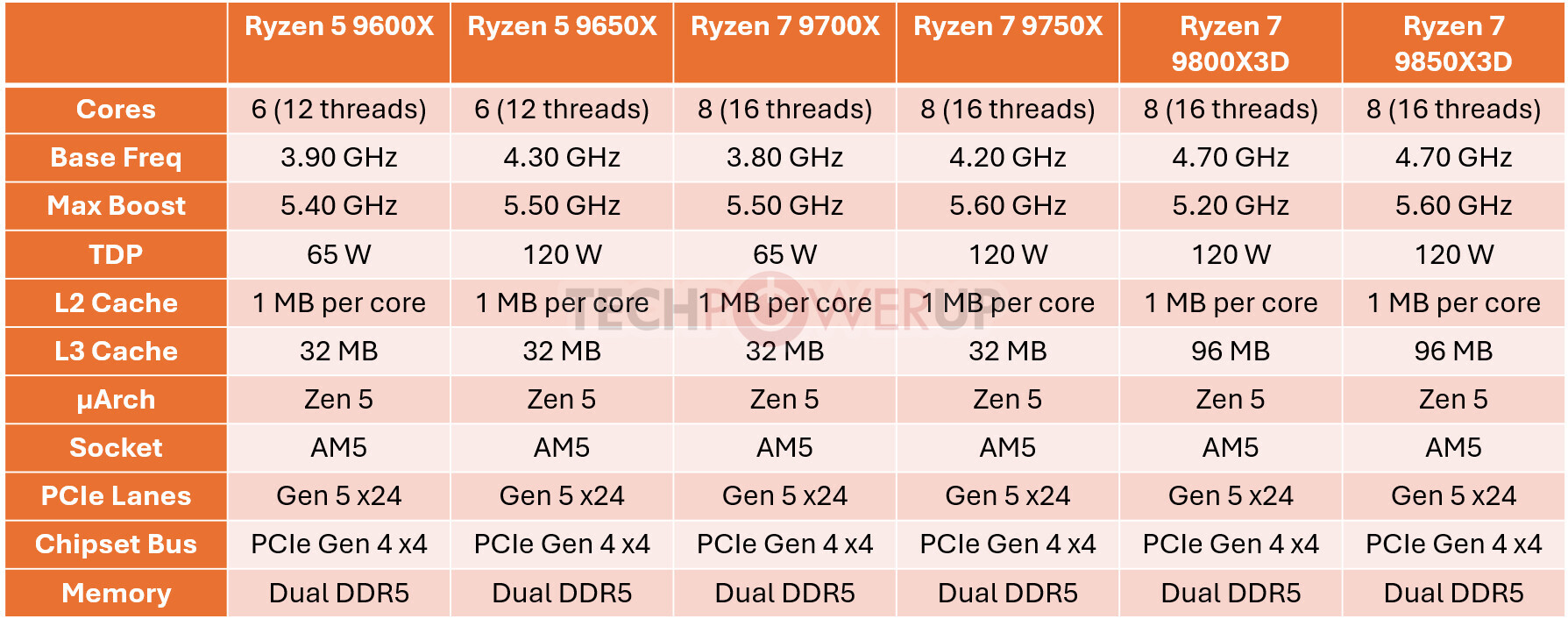
The Ryzen 7 9750X features 8 cores and 16 threads, utilizing AMD’s latest "Zen 5" architecture. This processor offers a base clock of 4.20 GHz and can boost up to 5.60 GHz, representing a notable improvement over its predecessor, the Ryzen 7 9700X, which had a 3.80 GHz base and 5.50 GHz boost frequency. The 9750X also comes with a 120 W TDP, a significant increase from the 65 W TDP of the 9700X. While the 9700X allowed motherboard vendors to enable a 105 W TDP mode via BIOS for improved performance, the 9750X raises the bar further by offering 120 W TDP out of the box. This higher power envelope is expected to provide more consistent boost frequencies and better overall performance for demanding workloads.
Ryzen 5 9650X: Mainstream Power with Higher Clocks
The Ryzen 5 9650X is a 6-core, 12-thread processor, also based on the Zen 5 architecture. It delivers a base frequency of 4.30 GHz and a maximum boost of 5.50 GHz, up from the 3.90 GHz base and 5.40 GHz boost of the Ryzen 5 9600X. Like its predecessor, the 9650X includes a full 32 MB of on-die L3 cache, ensuring ample bandwidth for multi-threaded applications and gaming scenarios.
Technical Overview and Market Position
Both the Ryzen 7 9750X and Ryzen 5 9650X are non-X3D models, meaning they do not feature AMD’s 3D V-Cache technology. Instead, they utilize the standard Zen 5 compute die (CCD) with 32 MB of L3 cache. These enhancements are aimed at users seeking higher clock speeds and improved performance without the additional cache layer found in X3D variants.
While AMD has not yet announced official pricing for these new processors, it is anticipated that the Ryzen 7 9750X and Ryzen 5 9650X will gradually replace the 9700X and 9600X at similar price points. This strategy is expected to provide consumers with more powerful options in the mainstream and enthusiast desktop segments.